360 degree feedback is a widely used tool for leadership development, performance insight, and when used strategically, organizational growth. When thoughtfully designed and executed, it provides leaders with a holistic view of their strengths and opportunities—helping them grow in ways that other assessments can’t match. It is likely the most robust form of feedback a leader can have other than a full-blown assessment center type of experience, which typically costs thousands of dollars for each leader.
The impact of a 360-degree feedback process, however, depends heavily on how well the process is implemented. We see many organizations making process decisions that inhibit the positive and strategic impact a 360-degree feedback process can have.
This article is designed to assist organizations in making strong, financially, legally, and culturally wise decisions regarding their 360-degree assessment processes. It builds on an article we wrote a few years ago on the same topic.
We recommend organizations use the following practices to have truly significant results from 360-degree assessment processes:
1. Make Sure There is a Clear and Transparent Purpose for the 360 Agreed on and Communicated
A successful 360 degree feedback initiative begins with clarity of purpose. Whether the goal is leadership development, culture building, team effectiveness, or targeted capability improvement, articulating the “why” upfront sets expectations and ensures alignment across stakeholders. Research consistently shows that unclear objectives lead to confusion, mistrust, and inconsistent outcomes. Clarifying success criteria, intended outcomes, and how the data will be used is a foundational best practice.
Organizations should explicitly communicate whether the 360 is for development only—the most common and most effective approach. Traditional 360s were not designed or validated to be used for any decision-making purposes such as promotion or compensation decisions. Organizations that use traditional 360 results to make decisions like this are risking legal risks.
For example, imagine the board of your organization decides to use a 360 process to gather feedback for the new President and to share this feedback with the board so they can be better understand how well the new President is performing. The board members know very little about 360 assessments and what it was designed for and the head of HR is unable to influence their thinking. So the organization completes the feedback process for the President. Imagine that the results are not very impressive. The board gets focused on the poorer results, for example, low ratings from direct reports on competencies like Lead Boldly or Champion Change. Somewhere along the line the Board Chairman tells the President their main concern from the 360 results and lets the President know the organization is asking for his resignation because he cannot accomplish the change the organization desperately needs. As far as the President can tell, the request is linked solely to the 360 results, and specifically to direct report feedback. This is a legal challenge waiting to happen.
So, work to ensure that the purpose of your organization’s feedback process is clear and agreed upon up front. If the thinking needs challenged, try to lead boldly to do that, especially if you are representing HR. Watch for our upcoming article on Legal Challenges for Using 360-Degree Feedback for Employment Decisions to learn more on this topic.
2. Align the 360 with Competency/Capability/Leadership Frameworks and Business Strategy
The most impactful assessments are tightly connected to an organization’s leadership expectations and strategic priorities. Building the 360 from a validated competency model—or aligning it to the company’s own framework—ensures relevance and resonance. This alignment helps participants see a clear line from organizational goals to their personal development focus.
When organizations select or design 360 instruments, the questions should reflect the behaviors and skills that matter most. Using well developed frameworks or custom content grounded in business strategy strengthens both acceptance and utility. It also facilitates alignment in building the kind of culture the organization wants to have.
For example, imagine that your organization has acquired another organization. The two organizations have similar cultures, but there are distinct differences. A new CEO and President has been appointed to lead the newly integrated organization and she is from the acquired organization. She has a huge task ahead of her to integrate and align the two organizations, cultures, and leadership behavior norms. There may be no better way to do this then to first create the competency/capability/leadership framework that she wants to represent the new integrated organization, and then to use the framework in a 360 process to get a baseline of where the leaders are at related to the defined framework. She can understand group themes and implement steps to address them.
Using custom 360s based on your organization’s framework can be the key difference between a 360 process which is viewed as a one and done event, and a 360 process that has strategic value and impact, and financial returns on investment.
3. Use Validated, Research Based Assessment Measures
While custom assessments can be aligned to organizational models, they should still be grounded in sound research. Poorly designed questions or survey structures can undermine credibility and reduce the value of the feedback. Recognize also that allowing people to design their own 360 content undermines the ability to have strategic impact through 360-related initiatives.
Using validated instruments helps ensure reliability, clarity, and actionable insights. Having a vendor say that their 360 is valid should not be taken at face value. Ask for technical manuals and other research supporting the validity of the 360 you use.
4. Ensure There is a Strong Process for Before, During and After the 360 Assessment
Have processes in place for prior to, during, and after the feedback reports are completed. Identify steps to support launching a 360, supporting a group when they are completing a 360, and transforming insight into action once 360 feedback is received. The processes do not have to be complex, but should be clear and identified early.
We have seen many organizations put so much planning, effort, and resources (including financial) into the event of receiving the 360 feedback. What gets the most neglected is the process that happens after people receive 360 feedback.
So, for example, many organizations include 360 assessments as part of their leadership development programs. They have groups of people (e.g., emerging leaders, first time leaders, senior leaders) participating in the programs. They spend 2 hours of the program reviewing the 360 process up front and 2 hours once the feedback reports are completed giving guidance on how to interpret the feedback. They often have coaches work with individuals or the group as a whole to help people turn the feedback into substantive action plans that they should discuss with their managers. The program ends a few weeks later and there is no follow-up or accountability for either the program participants or their managers to put forward an action plan and to actually work on that plan.
The program participants and their managers struggle with creating a really substantive plan that does create change and growth (as many people do). They struggle with where they put the plan and the fact that the format that exists on Workday or some other platform does not accommodate their needs. There is no way to easily access and share the plan with others, say in succession discussions. No one is following up, either.
This is a typical example of what happens in many organizations.
A company I worked for previously, Personnel Decisions International, used to have what they referred to as the Development Pipeline. It looked like this:

The idea was that for development to happen, whether for individuals, teams, or organizations, all of the components of the pipeline needed to be addressed. First, there needed to be awareness that change was needed, then a motivation to change, there had to be a way to learn new capabilities, opportunities to practice, and finally accountability for change.
Many organizations offer leadership development programs that help to build insight (for example, through a 360), help enhance motivation (for example, through feedback / coaching sessions), and teach new capabilities in their programs (for example, teaches people how to be a better coach). Where most organizations lose momentum is in providing opportunities to practice new capabilities without concerns, and definitely in terms of holding people accountable to make needed changes. What is wrong with holding leaders accountable for learning how to coach and attend to development? This is rather than being known as a leader who never has a feedback or coaching conversation and hands someone a check at performance review time without any conversation at all?
5. Make Sure There is Strong Communication and Training in the Rollout Process
First, make sure that the HR team and any internal or external coaches involved in the rollout are trained themselves on the 360 being used, how to use it strategically, related resources available, how to have strong coaching sessions and produce substantive action plans. Sometimes organizations do not invest in this training. They think that they have been using 360s forever, and have even been certified previously (10 or 20 years ago) on the 360 they are using. The value, strategic impact, and return-on-investment of your 360 process is only as good as the knowledge and capability of the people leading the process.
Second, participants and raters (those providing the feedback) need to be prepared. They need to know:
-
The purpose of the 360 – This was discussed in point #1 of this article.
-
What feedback they will be getting – This was discussed in points #2 and #3 of the article. Will people get feedback on the company’s framework competencies and behaviors? If so, this is an opportunity to communicate again about the importance of the framework and how it meant to align people throughout the organization. If the 360 has standard rather than custom content, still discuss why the content rings true for the organization.
-
The process they can expect – This was discussed in point #4 of this article.
-
Who will see feedback reports or the specific feedback a rater provides – Participants need to know who will have access to their feedback reports. Most organizations use a process where the internal or external coach meeting with a person to discuss their feedback gets the initial access to the feedback report. They share the report with the person 2 – 3 days prior to the feedback session. Typically, managers do not receive the feedback report. Rather, the participant will summarize the key themes, translate them into an action plan that is shared with the manager to reach agreement and alignment.
Raters should also know that unless they are one of the person’s managers, their exact feedback will be aggregated with others in their perspective group (e.g., direct reports, peers). This allows people to be as honest as possible and to better trust the process.
-
Participants need to know how to select raters – The typical rater perspectives for 360s include: Self, Primary Manager, Secondary Manager, Direct Reports, Peers, and Others. If a person has more than one manager, they certainly should include them. For direct reports, it is usually wise to ask for feedback from all of them. Leaving some out will cause them to wonder why. Plus, a person should have well-rounded feedback from their team. If they have indirect reports, they can be include in the Other group. For peers, a person should choose a range of peers who they have ongoing interaction with. As mentioned, the Other group could include indirect reports, board members, customers, or any other group that makes sense to ask for feedback.
Generally, at a minimum, people should have at least three people in a group, preferably 5 or more to get well-rounded results. Not everyone requested to participate will, so error on the side of asking too many rather than too few.
Selecting raters, however, is not about quantity, but quality and relevance. The most credible results come from individuals who interact regularly with the participant, understand their work, and can provide meaningful, behavior based insights. Poor rater selection can lead to skewed or unhelpful feedback, while well chosen raters boost the reliability of results and deepen participant insight.
Encouraging a balanced mix—manager, peers, direct reports, and sometimes customers or partners—ensures a well rounded view of leadership behavior and impact. - How to complete the assessment effectively – Both participants and raters need to be given information on how to complete the 360. For example, they should be introduced to the rating scale and given advice on how to use the scale. Use will include advice on avoiding typical rating errors such as:
- Halo Effect - Overly positive ratings because one strong quality “spills over” into all categories.
- Horns Effect - The opposite of the halo effect: one negative impression drags all ratings down.
- Leniency Bias - Raters consistently give higher scores than deserved, often to avoid hurting feelings or creating conflict.
- Severity Bias - The rater scores everyone harshly.
- Central Tendency Bias - Avoiding high or low ratings and clustering around the midpoint to “play it safe.”
- Recency Effect - Rating based mostly on the most recent events—good or bad—rather than overall performance across the rating period.
- Primacy Effect - Letting early impressions overshadow everything that came afterward.
- Similar-to-Me Bias - Higher ratings for people who share similar style, background, values, or personality.
- Contrast Effect - Ratings influenced by comparison with others instead of evaluating the individual against objective criteria.
- Attribution Bias - Assuming behavior is driven by personality rather than circumstances.
- Role-Based Expectations Bias - Raters score based on what they expect someone in that role to be like, not on actual observed behavior.
- Unconscious Bias - Implicit tendencies related to gender, age, race, tenure, or other factors that affect ratings without the rater realizing it.
- What to expect from the results – Let people see what a feedback report looks like and the kinds of feedback they will be receiving. Let them know what the process will be when they get their feedback report. How will they determine what is most important? Will they get help in interpreting the feedback report? Will they need to put together an action plan? What help will they get with that?
6. Support Feedback Interpretation with Coaching
Receiving a 360 report can be enlightening, but also overwhelming. Without support, participants may focus disproportionately on negative comments or misinterpret the data. Research underscores the importance of guided interpretation—whether through one on one coaching, facilitated group sessions, or structured self reflection. Facilitators can help leaders identify themes, contextualize feedback, and build development plans rooted in strengths and growth opportunities.
To be sure, having coaches working one-on-one with people to help them get the most out of their feedback can be expensive. Many organizations will provide one-on-one coaching for senior leaders, have facilitated group sessions for mid-level leaders, and have other means of structured self-guidance for individual contributors for example.
Today, with Artificial Intelligence incorporated into some 360s, people can get real-time interactive assistance, coaching, and advice in interpreting their feedback, and asking for and receiving additional coaching based on their exact 360 results (click here to get more information on our PROFILOR® | ADVISOR+, which combines the science of The PROFILOR® with the power of AI).
7. Ensure Support and Commitment to Development Action Planning and Implementation
Many people get stuck at the spot where they need to translate their feedback into substantive action plans. They need help in knowing how to do that. Help them understand:
- If the organization has a preferred format for action plans – Is it housed and easily accessible on a platform? Are there samples provided to guide their thinking? What should be included in a plan?
- How do they know if there are strengths they have that they should seek to leverage more or differently as part of their plan.
- How do they know which areas they should work on improving to have the greatest return on their development investment?
A substantive plan should definitely result in people noticing changes in 6 months. In a year, a substantive plan should result in noticeably improved 360 feedback results.
HR teams need to also look closely at where they are housing development plans and determine if the platform works well for people or needs to be changed. When individuals and their managers don’t have easy ways to input, access, or share action plans, it is frustrating, and can be an obstacle to the follow-through process that is planned to happen after people receive 360 feedback.
Organizations need to be committed to the action planning and follow-through process. It relates to ensuring people, especially leaders in the organization, are accountable to continue to improve for the benefit of themselves, their stakeholders, and the organization. Accountability, as mentioned previously, is that last component in the Development Pipeline. This is where many organizations fall short.
8. Improve Accountability and Impact and Demonstrate ROI Through “Time 2” 360s
Many organizations make decisions to implement only an initial 360 process, and not implement any type of “Time 2” 360. That is a penny-wise and pound-foolish decision that is not highly strategic nor truly invested in growth and development. A follow-up Time 2 360, whether a streamlined pulse check 6 months later (such as our Progress Check) or a full Time 2 one year later (such as our Momentum365) enhances the accountability for participants to stay engaged in their own development and also keeps key stakeholders, such as primary managers, engaged in the process.
In addition, we know that many organizations do not assess the ROI of their 360 feedback processes. There are a number of reasons why not but primary among them is that it is difficult to prove causality. For example, how do you know the extent to which 360 feedback led to improved capabilities or something else?
Including Time 2 assessments is one of the easiest ways to determine if people are improving and if efforts to help them are worthy.
9. Use the 360 Process Strategically, and Not Only for Individual Development
We encourage organizations to look at 360-degree feedback as part of an integrated organization intervention to improve development and growth, strategic impact, and return-on-investment.
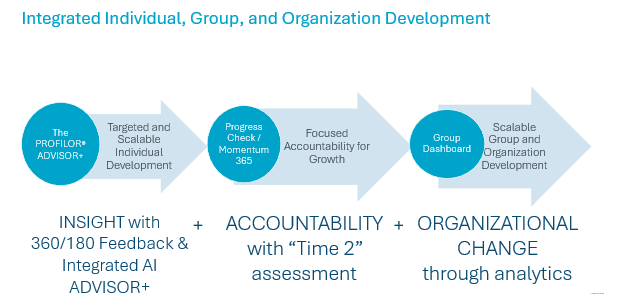
If your organization is using 360s with any volume, it should not only be looking at individual impact, but also group and organizational impact. This is where group reporting comes in. This can be either static PDF group reports or preferably interactive group / organizational dashboards.
With interactive dashboards, you have access to your 360 data and the ability to sort the data by the variables that are important to your organization (e.g., function, geography). You can identify themes and trends for one group versus another, or look at the entire group more broadly. You can identify key strengths and development areas for groups and across the organization.
With your Time 2 data, you can also see extent of improvement on key competencies and behaviors over time. With certain types of Time 2 360s (like our Progress Check), you can see what competencies and behaviors people are choosing to work on and whether or not they are tending to improve with their efforts.
This group/organization data can be key to learning needs analysis and the design of subsequent learning initiatives. It can also be key to broader organization development efforts.
10. Provide Organizational Support and Follow Through
As summarized throughout this article, the most successful 360 programs are not one time events—they are part of a broader development system. Organizations should provide ongoing support through coaching, learning resources, progress check ins, and tools that reinforce sustained behavior change. Research shows that 360 initiatives with follow up are significantly more effective in driving long term growth than those without it.
Ensuring alignment between the 360 process and broader talent strategies—leadership pipelines, succession planning, capability building—helps embed development into the culture.
Conclusion
A well implemented 360 degree feedback process can be a powerful catalyst for individual growth and building organizational capability. The most impactful programs are rooted in a clear purpose, connected to business strategy, supported by research based tools, and reinforced with meaningful support, resources, and follow through.
When organizations design their 360 process with clarity, trust, and developmental intent, they create an environment where leaders gain deeper self awareness, strengthen critical behaviors, and accelerate their impact.
Assessments International will be publishing a more comprehensive version of this article in booklet form. This will include additional resources such as sample communications and action plans. Subscribe to our blog below to get access to this booklet when it is released. And follow us on LinkedIn to stay up to date on the booklet and all of our other news and research.