
360-degree feedback processes have been used in organizations since the 1950s, when the Esso Research and Engineering Group (now known as ExxonMobil) became the first company to document its use of multi-rater feedback processes. Despite 360-degree feedback being used for three-quarters of a century now, there has not been a specific and consistent process in place to evaluate the effectiveness of these processes. This article will address this gap and outline the “360 Process Impact Model.”
Kirkpatrick Evaluation Model
Of course, the Kirkpatrick Evaluation model was developed by Donald Kirkpatrick in 1959 as a means of understanding how an organization’s training or educational process is functioning, and how people within it are performing. Even after over 60 years, the model continues to be the most well-known and widely used means of evaluating the effectiveness of training programs. While in practice, this model has been applied largely for evaluating training programs, its authors frame it as “The Standard for Leveraging and Validating Talent Investments®.”
For comparison purposes, the Kirkpatrick Evaluation model outlines four levels for measuring effectiveness:
- Level 1: Reaction – Reaction measures the degree to which the target audience finds an experience or initiative favorable, engaging, relevant, and supportive of the work needed to achieve the targeted outcomes.
- Level 2: Learning – Learning measures the degree to which the target audience acquires the intended knowledge, skills, attitude, confidence, and commitment necessary to achieve the targeted outcomes.
- Level 3: Behavior – Behavior measures the degree to which the target audience performs the critical behaviors in its environment and is supported and accountable for its performance.
- Level 4: Results – Results measure the degree to which targeted organizational outcomes occur as a result of an experience or initiative and development support.
How Development Happens
Before looking at a new model for evaluating the effectiveness or impact of 360 processes, it is important to look at how development happens for individuals, groups, or organizations.
A company this author worked for previously, Personnel Decisions International (PDI; since acquired by Korn Ferry), used to have what they referred to as the Development Pipeline. It highlighted five conditions that are needed for development:
- Insight – Do people know what to develop?
- Motivation – Are people willing to spend the time and energy to develop themselves?
- Capabilities – Do people know how to acquire the skills and knowledge they need, and do they acquire them?
- Real-World Practice – Do people have opportunities to try their new skills?
- Accountability – Do people internalize new capabilities to improve performance and results? Are they held accountable and rewarded for development?
The idea behind the Development Pipeline (originally depicted as a pipe with five segments) was that for development to happen, whether for individuals, teams, or organizations, all of the components of the pipeline needed to be addressed. First, there needed to be awareness or insight that change was needed, then a motivation to change. There had to be a way to learn new capabilities, opportunities to practice, and finally accountability (internal and external) for change. If any of these conditions were constrained or blocked in the pipeline, growth would be constrained as well. That constraint needed to be addressed for growth to continue to happen.
Any model designed to assess the effectiveness or impact of 360-degree feedback processes should consider the broader context of how development happens.
360 Process Impact Model
Many organizations do not assess the effectiveness, impact, or ROI of their 360-degree feedback processes. There are several reasons why, but primary among them is that it is difficult to prove causality. For example, how do you know the extent to which a 360-degree feedback process led to improved capabilities versus other factors that may have influenced improvement (e.g., a person got a new Manager or participated in an Advanced Management Program at a renowned university)?
In addition, ROI is often calculated in more quantitative terms. Showing the direct connection between a 360-degree feedback investment and dollars made or saved by an individual or individuals who has/have learned something significant as a result of a 360 is difficult. And, learning and development take time, and the more time it takes, the more other factors come into play, making it difficult to tease out the impact of the 360-degree feedback process alone.
Some recent data (Rose & Biringer, 2025) did show that among a sample of participating companies, 83% noted that 360-degree feedback processes helped leaders to make better decisions; 64% viewed 360-degree feedback as a tool to increase retention of high-potential leaders; 11% noted benefits in each of the following areas: decreased turnover and increased customer satisfaction.
While there can be difficulties in demonstrating ROI and causality for 360-degree feedback processes, that should not mean that we don’t try to measure effectiveness and impact. This type of measurement can reveal a lot that 360-degree feedback users should know. Therefore, we are recommending a new framework for evaluating 360 effectiveness and impact.
While there are aspects of the Kirkpatrick Evaluation model that might apply for use with evaluating the success of 360-degree feedback processes, we think a more specific model can produce stronger insights about the success of these processes, and subsequently greater return-on-investment and strategic impact for these processes. We also think it is important that a model for measuring 360 effectiveness or impact be more directly tied to the five conditions for development.
Figure 1 shows the three levels of impact that any 360 process can, and should, have. The effectiveness and impact of any 360 process can be evaluated at each of these three levels. The first level of impact that organizations should expect to find from a 360-degree feedback process is internal to a person and includes improved self-insight, as well as potential motivation for change. The second level of impact is more easily seen by others and takes the form of behavior change. Sustaining the behavior change over time is the desired outcome. At some point, the new behavior may need to change as well as a person grows or changes roles or desired impact. The third level of impact is organizational impact. For example, did 360-degree feedback result in improved leadership across the organization, which in turn, resulted in improved employee morale, engagement, and retention?
Figure 1
Three Levels of Impact for 360-Degree Feedback Processes
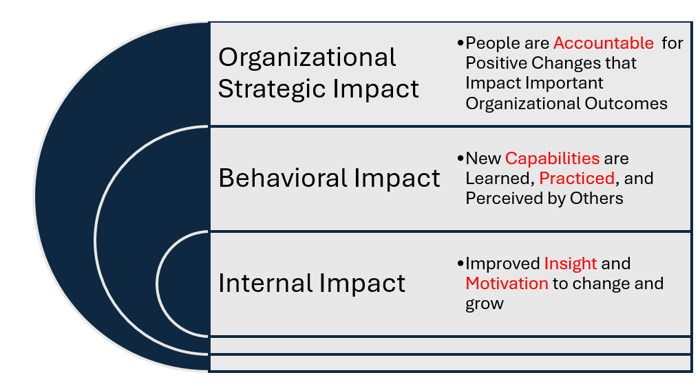
Level 1: Internal Impact – Internal impact can include, but goes beyond, Kirkpatrick’s “Reactions”. Most importantly, internal impact happens when 360 feedback evokes a new or evolved insight, or motivation to change, grow, and develop. These relate to the first two conditions for development to occur in the Development Pipeline.
To assess internal impact, the best approach is to survey participants right after they complete a 360-degree feedback process. While there may be additional questions an organization wants to ask in the survey, it is recommended to ask the following questions:
- Did the 360-degree feedback results improve your self-awareness about any topic? If so, what self-insights did you have?
- Is there anything you will do differently as a result of these insights? If so, what and why?
- Are you motivated to make some changes or learn new capabilities or behaviors as a result of the 360-degree feedback you received? Does your organization provide ways you can learn these new capabilities or behaviors?
- Was the 360-degree feedback process helpful in understanding how you can better contribute to the organization’s strategies? If so, how?
- Do you know how to put together a strong development action plan for yourself? If not, how will you get assistance?
- How will the 360 feedback help you to contribute to the organization’s vision and strategies?
- What will you do differently as a result of the 360-degree feedback to help improve your organization’s engagement results?
- What will you do differently as a result of the 360-degree feedback to help people in your organization understand the development opportunities they have available to them?
- What will you do differently as a result of the 360-degree feedback that could reduce dysfunctional turnover in the area you lead?
- What strengths do you have that were noted in the 360 feedback that you might want to leverage more or differently because they are strategic differentiators for you in this organization?
- What competency areas noted in the 360 feedback should you improve because they are important to the organization’s strategies?
- What specific behaviors noted in the 360 feedback should you improve because they are important to the organization’s strategies?
Level 2: Behavioral Impact – Behavioral impact happens when new behaviors or capabilities are learned, practiced, and perceived by others. This includes both Kirkpatrick’s “Learning” and “Behavior” evaluation levels. In Kirkpatrick’s model, Learning is traditionally measured using pre- and post-tests related to training programs. A similar line of thinking can be applied to assessing behavioral impact in the current model.
To assess behavioral impact, there are “Time 2” type assessments that can be completed by the same raters who provided initial 360-degree feedback. These can be either full Time 2 assessments (Assessment International’s version is “Momentum365”), where raters provide feedback on improvement or decline for every behavior. These are often completed one year after the original 360 process. There are also streamlined Time 2 assessments. For example, a person might ask specifically for feedback on selected behaviors that they have been working on improving. These “pulse check” (Assessment International’s version is “Progress Check”) streamlined types of assessments often occur six months after the original assessment.
Time 2 type assessments can help an individual see whether people are noticing improvements. Time 2 assessments can enhance the accountability for participants to stay engaged in their own development and also keep key stakeholders, such as primary managers, engaged in the process. Including Time 2 assessments is one of the easiest ways to determine if people are improving and if efforts to help them are worthy.
Level 3: Organizational Impact – Organizational impact happens when behavior change occurs across the organization. Behavior change that facilitates the organization’s vision and strategies results in organizational strategic impact. Organizations implementing 360 processes should always aim for strategic impact. Our recent Guide, “Best Practices in 360 Use and Strategic Impact,” provides several specific recommendations for enhancing strategic impact for 360 processes.
It is important to clarify up front what organizational impact you want to have through 360 processes. Any of the following might apply:
- Your organization has a new leadership framework, and you want to reinforce and build the competencies and behaviors outlined in this framework
- The leaders in your organization seem ill-equipped to drive the strategic vision forward; you need to understand why and address the needs
- Your organization has had engagement survey results that need improvement, and the data suggests the biggest contributing factor is leadership
- Your organization experiences substantial turnover, and you think a big cause is that leadership lacks important leadership skills to retain talent
Depending on the outcomes/impact you want to have through a 360 process, you can tailor how you will address the need and how you will measure success. For example, maybe your engagement survey results tell you that people in your organization don’t see opportunities for development, and the leaders are not providing coaching, communication, or support related to development opportunities. This is also likely related to high turnover.
Whatever the outcomes you are trying to facilitate, you can assess organizational strategic impact in various ways related to 360 processes. For example, in the survey you provide after the 360-feedback process is completed, consider including questions like the following (depending on the outcomes you are seeking):
You can also enhance and assess first-level strategic impact through aggregate reporting with the original 360 data and the Time 2 data you have. With the original 360 data, aggregate reporting can reveal:
- If people and their leaders agree on the competencies that are most important to success in their roles, given the organizational context and strategies
- The most important competencies and behaviors that may be strengths for your leaders, and they can leverage more or differently to facilitate strategies
- The most important competencies and behaviors that are weaknesses for your leaders and impede strategic goals
Through this data, communication, learning, and development plans can be prioritized and implemented. At a later point, Time 2 aggregate data can reveal:
- Competencies and behaviors people choose to work on improving; people should ideally be choosing those that are most important to the organization’s strategies and success
- Competencies and behaviors most and least improved over time – ideally, most improved competencies and behaviors are those most important to the organization’s strategies and success
- The extent to which people are noticing the person is putting forth effort to grow and improve
- How to best adjust the organization’s learning and development priorities and other talent processes to continue to build the competencies and behaviors most related to strategic success
The aggregate reporting will tell you if you are making progress in building the skills needed for success in your organization.
In addition to the first-level evidence of strategic competence being built in the organization, you can also assess second-level impacts, such as improvement in engagement results or reduction of dysfunctional turnover. While it is true that it will be difficult to measure causality or the extent to which 360-degree feedback caused these results, it does not mean you should not track the desired outcomes, such as engagement results and turnover. Even if many factors are working together to improve these outcomes, 360-degree feedback and learning and development processes can be major contributors.
Importantly, too, remember that the extent to which the organization sets the stage for people to grow and develop and expects change and growth from people, especially leadership, is directly related to the organization’s ability to achieve strategic priorities. This relates to the last two factors in the Development Pipeline.
Conclusion
Kirkpatrick’s evaluation model notes that it is critical to start with Level 4: Results. The idea is that you need to start with the ends in mind – knowing what outcomes and results you are seeking from any talent process you implement. Agreed. Even though the three levels of impact were outlined starting with Level 1, it is critical that you have the desired organizational outcomes in mind even when you are assessing Internal Impact (e.g., insight, motivation).
The goal of this article was to advance understanding, acceptance, and use of evaluation methods for 360 processes – specifically the “360 Process Impact Model” proposed herein.
Visit us at www.assessmentsinternationalinc.com to learn more about how we support your organization’s strategic 360 experience.
Source: Rose, D.S. & Biringer, J.C. (2025). Current Practices in 360-Degree Feedback (8th ed.), Berkeley, CA: 3D Group.